
3. Cost recovery model
3.1 Outputs and business processes of regulatory activities
To help protect human health and the environment, AICIS carries out regulatory and support activities across several areas. In line with the AGCRP, AICIS organises its activities according to their regulatory outputs, ensuring they are accomplished through their relevant business processes. Table 1 below shows the breakdown of an activity into outputs and processes – these are representative, not exhaustive.
Table 1 – Activity, outputs and processes concept
| Activity | Outputs Aligns to charge point | Processes |
|---|---|---|
| Activities are made up of outputs, which together form regulatory and supporting activities to control or influence behaviour, manage risk and/or protect the community and the environment. | A regulatory output is the aggregated total of its associated business processes, which are transformed into cost recovered outputs. | Business processes encompass a series of tasks that are performed by people or systems to produce an output. |
See the breakdown of AICIS’s activities into outputs, processes and charging methods in Tables 2 to 10 below.
Table 2 – Scientific assessment and evaluation of industrial chemicals
| Activity | Outputs | Key business processes | Charging method |
|---|---|---|---|
AICIS undertakes pre- and post-market assessments/evaluations to identify potential risks to human health and/or the environment that may be associated with the introduction and use of industrial chemical(s) in Australia. AICIS issues assessment certificates and commercial evaluation authorisations for the introduction of unlisted industrial chemicals into Australia following a pre-market assessment. AICIS makes recommendations to relevant risk management agencies, where required, to ensure appropriate controls are in place. | Assessment certificate and assessment statement | Consider application by:
Decision on application:
| Fee for service |
| Commercial evaluation authorisation | Consider application by:
Decision on application:
| Fee for service | |
| Evaluation Statement | Initiate evaluation by:
Evaluation of chemicals:
| Levy |
Table 3 – Maintain the Australian Inventory of Industrial Chemicals
| Activity | Outputs | Key business processes | Charging method |
|---|---|---|---|
AICIS maintains the Inventory database of chemicals available for industrial use in Australia, containing chemical identity details, regulatory obligations or conditions relating to the importation and manufacture of industrial chemicals. Chemicals listed on the Inventory are authorised for introduction, so long as those introductions meet the relevant associated regulatory obligations. | Listing on Inventory before 5 years from certificate issue date | Consider application by:
| Fee for service |
| Listing on Inventory at 5 years from the certificate issue date |
| Levy | |
| Variation of Inventory listing | Consider application by:
Decision on application:
| Fee for service | |
| Levy | ||
| Continued protection of confidential information | Provide written notice of review of protection:
Consider application by:
Decision on application:
| Fee for service | |
| Confidential Inventory searches |
| Levy | |
| Applying to be a confidence holder in relation to confidential listings (transitional chemicals) | Consider application by:
Decision on application:
| Fee for service |
Table 4 – Provide information and recommendations about the risks and uses of industrial chemicals
| Activity | Outputs | Key business processes | Charging method |
|---|---|---|---|
| Assessment / evaluation statements are published on the AICIS website for use by all stakeholders, including other Australian Government and state and territory regulatory agencies such as public health, worker health and safety, environmental, transport and consumer product safety agencies. | Industrial chemical notices and statements | Publish notices and statements on the AICIS website with related terms and reasons for:
| Levy |
| Risk Management Recommendations Register |
| Levy |
Table 5 – Fit-for-purpose regulation
| Activity | Outputs | Key business processes | Charging method |
|---|---|---|---|
| The Industrial Chemicals (General) Rules 2020 and the Industrial Chemicals Categorisation Guidelines are regularly reviewed and updated to ensure AICIS regulation remains contemporary and fit-for-purpose, within existing policy settings. | Set and maintain the Industrial Chemicals Rules, Categorisation Guidelines, and guidance |
| Levy |
Table 6 – Meet obligations under international agreements for import and export of restricted industrial chemicals
| Activity | Outputs | Key business processes | Charging method |
|---|---|---|---|
| AICIS can approve, restrict or prohibit the introductions or export of industrial chemicals listed in international conventions and assists Australia to meet its obligations by undertaking compliance monitoring and enforcement activities relating to industrial chemicals under the Rotterdam and Minamata Conventions. | Approved / Not Approved import or export of restricted industrial chemicals subject to international agreements | Process applications, decide and provide response to:
| Fee for service |
Compliance monitoring of restricted industrial chemicals under the Minamata or Rotterdam Convention agreements including:
| Levy |
Table 7 – Enhance scientific, data and chemical intelligence expertise, and harmonise international best practice
| Activity | Outputs | Key business processes | Charging method |
|---|---|---|---|
AICIS scientific assessments incorporate the best available scientific evidence, use modern risk assessment tools and approaches, use data driven decisions, and risks and means for managing risks are clearly described. AICIS works with other countries to harmonise and adopt (where applicable in the Australian context) international standards and risk assessments methods. | Chemical intelligence |
| Levy |
| Strengthened international arrangements and active participation in international activities |
| Levy | |
| High-quality scientific risk assessments |
| Levy |
Table 8 – Compliance monitoring and investigate breaches of the Industrial Chemicals Act 2019
| Activity | Outputs | Key business processes | Charging method |
|---|---|---|---|
| AICIS undertakes activities such as compliance monitoring of introducers and introductions of industrial chemicals under the IC Act, managing compliance cases, and liaising with other Australian enforcement agencies. | Introducers are registered | Compliance monitoring of:
| Levy |
| Reported introductions are authorised |
| Levy | |
| Exempted introductions are authorised |
| Levy | |
| Listed introductions are authorised |
| Levy | |
| Compliance of annual declarations for all introduction categories |
| Levy |
Table 9 – Registration of industrial chemical introducers
| Activity | Outputs | Key business processes | Charging method |
|---|---|---|---|
| Registration of industrial chemical introducers enables AICIS to identify entities introducing industrial chemicals and supports effective regulatory oversight. | Register of Industrial Chemical Introducers |
| Fee for service |
Table 10 – Corporate and regulatory support activities
| Activity | Outputs | Key business processes | Charging method |
|---|---|---|---|
| Corporate and regulatory support activities support the efficient and effective administration of the scheme. | Industrial Chemicals Special Account |
| Levy |
| AICIS website and communication |
| Levy | |
| Stakeholder Engagement Committee |
| Levy | |
| Business planning and regulatory reporting |
| Levy | |
| AICIS Business Services |
| Levy |
3.2 Costs of the regulatory activity
3.2.1 Cost drivers
AICIS is committed to effectively delivering legislative and regulatory functions at the minimum and most efficient cost. The scheme estimates its cost base using 3 key cost drivers:
- effort required to deliver each business process and activity
- resource cost to conduct each business process and activity
- annual volume of each activity performed.
On this basis, AICIS’s cost base can be summarised as:
The total effort (hours) to undertake required business processes and activities, multiplied by the applicable hourly rate, multiplied by the annual volumes of business processes completed.
See below for details on the methodology and approach for estimating each driver. This calculation is shown in Section 3.2.3 for cost calculation methodology.
AICIS has identified the most efficient costs across the organisation’s key business processes, where each staff member records the effort and time taken to complete activities and outputs. AICIS reviews its effort capture data on an ongoing basis to understand any shifts in effort requirements. AICIS also reviews its business practices to ensure continued efficient service delivery.
Effort
When AICIS was established, the scheme based its regulatory charging on historical effort data from similar NICNAS activities (where available) in combination with estimates for new activities. Through ongoing monitoring and analysis of its effort data, AICIS has identified fundamental differences between the 2 schemes that limit the value of historical data as a reliable representation of the true effort and associated costs for all regulatory activities.
To refine effort and cost estimates, historical data is replaced with actual AICIS data collected through detailed effort and time capture activities as it becomes available. AICIS staff continue to record the effort spent across all functions.
Resources
AICIS operates efficiently by drawing on a broad and flexible mix of resources.
Its primary workforce comprises ongoing Australian Public Service (APS) employees who assist the Executive Director. This includes staff of the DHDA, as well as DCCEEW staff who deliver the environmental component of risk assessments under a Service Level Agreement. The cost of this work is included in AICIS’s cost base.
To respond to changing demand and scale capacity, AICIS occasionally supplements APS capacity and capability with modest use of external suppliers, including consultants and contractors. This flexible approach supports delivery at minimum viable cost while maintaining service standards, and enables AICIS to achieve cost-effective outcomes without compromising its regulatory responsibilities.
AICIS’s forward year cost base is indexed to recognise inflation. It also ensures that budgets and forecasts reflect any likely future costs. The applied indexation rate is weighted to reflect the relevant proportion of both:
- Employee costs – recognised through the Wage Price Index (WPI)
- Supplier costs – recognised through the Consumer Price Index (CPI) or equivalent rate.
Volumes
AICIS forecasts its annual volumes of each activity by using the previous year’s actual volumes as a baseline. AICIS staff then analyse the data and model their upcoming estimate volumes on market trends. They use the technical analysis results and overlay with existing business knowledge to calculate the forecast volumes for each charge point. As more introducers register with AICIS, the depth of technical analysis increases as the scheme matures, due to greater availability of data and annual sample sizes over time. Regulated entities are also gaining a better understanding of their regulatory obligations and improving their relationships with AICIS. The scheme improved its registration revenue forecasting by introducing real-time intervention in 2025–26. AICIS staff identified introducers who under-declared their introduction value and upgraded them to the actual introduction value.
3.2.2 Cost base
The cost base entirely covers the total estimated costs of efficiently and effectively delivering AICIS’s regulatory functions. Costs such as those incurred for policy functions by areas within DHDA are specifically excluded from the cost base, as these are funded by government or other mechanisms.
Table 11 – AICIS’s estimated cost base, 2026–27 to 2029–30 ($’000)
| Expenses | 2026–27 | 2027–28 | 2028–29 | 2029–30 |
|---|---|---|---|---|
| Employee and contractor expenditure | 16,461 | 16,971 | 17,497 | 18,040 |
| Non-employee expenses: | ||||
| Supplier (including DCCEEW) | 7,854 | 8,039 | 8,159 | 8,281 |
| Total1 | 24,315 | 25,010 | 25,656 | 26,321 |
1 The total estimated cost base includes the cost of activities considered non-recoverable under the AGCF. These costs will not be recovered through the proposed fees and charges as indicated in Table 11. Increases across the forward estimates reflects forecasted indexation (i.e. wage and supplier cost indices) rather than real growth in AICIS’s underlying activities.
AICIS’s activities to regulate the introduction of industrial chemicals under the IC Act can be grouped into 2 broad categories: regulatory and support outputs.
Regulatory outputs are those that AICIS provides to an individual or organisation, or those it provides to a broader group of individuals and organisations. In 2026–27, AICIS will continue to recover the costs of its regulatory activities using both fees and charges (levies), based on the demand for a government activity or intervention. These can include both direct and indirect costs. Direct costs can easily and accurately be traced to a regulatory output. Support outputs include indirect costs which are those that cannot be easily linked to an output. Indirect costs usually relate to overhead costs such as support staff salaries and technical support or property and are therefore distributed across outputs using appropriate cost drivers.
From 2025–26 onwards, depreciation will only be reported for IT products that meet the capitalisation criteria under ‘AASB 116 Property, Plant and Equipment and AASB 138 Intangible Assets’. Following a 2023–24 review by the department, AICIS’s IT build at the time was reclassified as a Software as a Service (SaaS) arrangement. Under this model, IT costs will be recognised as expenses when incurred, rather than AICIS owning capitalised assets that depreciate over time.
Table 12 outlines regulatory outputs and support activities classified as either direct or indirect costs.
Table 12 – Examples of AICIS regulatory and support outputs as direct and indirect costs
| Regulatory outputs: Direct costs (fees for services) | Regulatory outputs: Direct costs (cost recovery levies) | Support outputs: Indirect costs |
|---|---|---|
| Registration of introducers | Compliance monitoring and enforcement | Management of the Special Account |
| Assessment certificate applications | Post-market evaluation of chemicals | Enhancing scientific expertise |
| Commercial Evaluation Authorisation applications | Pre-introduction reports and post-introduction declarations | Corporate governance |
| Inventory early listing and variation applications | Maintenance of Inventory | Fit for purpose legislation |
| Confidential business information (CBI) protection applications | Stakeholder engagement/education | Website and IT |
| Applications for import / export of restricted industrial chemicals into or out of Australia | Enquiries and complaints management | Regulatory and business reporting |
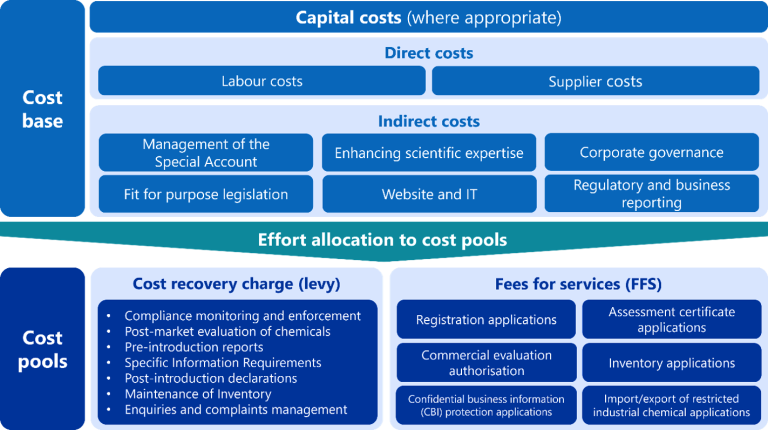
AICIS uses an activity-based costing (ABC) methodology to allocate all direct and indirect costs incurred by AICIS for each activity and its charge point. The cost base includes:
- Direct costs – costs that can be directly linked to a specific activity such as labour costs, supplier costs, etc.
- Indirect costs – costs that cannot be directly linked to a specific activity and is shared across activities, assigned to activities based on appropriate activity drivers. The drivers demonstrate the relationship between the service costs and reflect how much each activity uses those services shared across activities, such as corporate costs (e.g. finance, human resources and property etc).
- Capital costs – including depreciation and capital investment, where appropriate.
Figure 1 below shows AICIS’s activity-based cost model. See an example of how AICIS calculates a fee-for-service item under Section 3.2.3 of 'Cost calculation methodology’.
Figure 1 – Activity-based cost model
Using the ABC methodology, Table 13 shows the estimated total cost of regulatory activities, including AICIS’s support function cost.
Table 13 – Estimated cost by regulatory output for 2026–27 ($’000)
| Regulatory output | Fee or Levy | Direct costs | Indirect costs | Total costs |
|---|---|---|---|---|
| Registration applications | Fee for services | 318 | 314 | 632 |
| Certificate applications | Fee for services | 450 | 285 | 735 |
| Authorisation applications | Fee for services | 10 | 6 | 16 |
| Inventory listing applications | Fee for Services | 33 | 32 | 66 |
| Confidential business information (CBI) protection applications | Fee for services | 42 | 35 | 77 |
| Import / export of industrial chemicals into or out of Australia applications | Fee for services | 11 | 10 | 21 |
| Compliance monitoring and enforcement | Levy | 3,300 | 2,510 | 5,810 |
| Post-market evaluation of chemicals | Levy | 8,778 | 5,063 | 13,841 |
| Pre-introduction reports | Levy | 129 | 105 | 234 |
| Specific Information Requirements | Levy | 321 | 261 | 583 |
| Post-introduction declarations | Levy | 190 | 155 | 345 |
| Maintenance of Inventory | Levy | 704 | 573 | 1,277 |
| Stakeholder engagement/education | Levy | 158 | 129 | 287 |
| Enquiries and complaints management | Levy | 197 | 161 | 358 |
| Total | 14,643 | 9,639 | 24,282 |
Note: Total cost figures include direct and indirect costs and may not total due to rounding.
3.2.3 Example of cost calculation methodology
The charge for any specific regulatory output should recover the full efficient cost of delivering that specific service.
Table 14 provides an example of how the methodology is applied to calculate the cost of a regulatory output, specifically for ‘Registration of industrial chemical introducers’. The table details each component by outlining the relevant business processes and activities.
Table 14 – Total cost calculation of ‘Registration of industrial chemical introducers’
| Activity | Regulatory output | Effort required (hours) | Average cost per hour ($) | Cost per delivery of regulatory output ($) | Volume delivered annually | Total cost of regulatory output ($) |
|---|---|---|---|---|---|---|
| Registration of industrial chemical introducers enables AICIS to identify entities introducing industrial chemicals and supports effective regulatory oversight. | Register of Industrial Chemical Introducers | 0.56 | 155.17 | 86.72 | 7,285 | 631,755 |
Table 15 details the subtasks of each business process completed to achieve the regulatory output. It specifies the role, effort and cost required to perform each task.
Table 15 – Detailed cost calculation breakdown of the business processes for ‘Registration of industrial chemical introducers’
| Regulatory output | Business processes | Role performing task | Hours of effort | Cost per role ($) |
|---|---|---|---|---|
| Register of Industrial Chemical Introducers |
| Registration Support Officer | 0.36 | 55.30 |
| Registration Officer | 0.10 | 14.94 | |
| Assistant Director of Corporate | 0.10 | 14.97 | |
| Director of Corporate | 0.01 | 1.51 | |
| Total | 0.56 | 86.72 |
Table 16 details the subtasks for each of the 5 activities completed by an AICIS Registration Support Officer as part of the business process for ‘Maintaining register of industrial chemical introducers’. The table shows the hours of effort required to complete the tasks and the cost per hour of the role, which totals the cost of the task.
Table 16 – Total cost calculation of ‘Registration Support Officer’
| Business processes | Role performing task | Role cost per hour ($) | Hours of effort per task | Cost per role ($) [Role cost per hour] x [Hours of effort per task] |
|---|---|---|---|---|
| Registration Support Officer | 155.17 | 0.36 | 55.30 |
Table 17 shows both the direct and indirect costs per hour for the role of a Registration Support Officer.
Table 17 – Cost calculation breakdown of Registration Support Officer by direct and indirect cost
| Role | Direct cost per hour ($) | Indirect cost per hour ($) | Total cost per hour ($) |
|---|---|---|---|
| Registration Support Officer | 78.1 | 77.07 | 155.17 |
3.3 Aligning charging to regulatory effort
3.3.1 Aligning fees for services to regulatory effort
AICIS’s approach to activity-based costing aims to:
- confirm the level of effort used for a regulatory activity is relative to the risk
- ensure the scheme delivers the outputs at the minimum efficient costs.
As shown in Table 13, certificate applications and registration applications are the 2 largest regulatory outputs AICIS recovers through cost recovery fees, followed by Inventory listing applications and CEA applications.
Registration applications
The IC Act imposes an annual registration fee and levy (where relevant) on all introducers of industrial chemicals. Annual fees recover the registration application costs for individuals and businesses to register with AICIS, and for AICIS to maintain the Register of Industrial Chemical Introducers. The Corporate Services function of AICIS provides these activities to the individual or organisation, and manages the scheme’s:
- registration enquiries
- helpdesk support for the Business Services portal
- registration refunds.
This work uses a high level of regulatory effort to meet the volume of registration applications. See Section 3.2.3 'Example of cost calculation methodology’ for more about the cost calculation methodology for registration applications, including the detailed breakdown of related activities.
Assessment certificate applications, CEA applications and Inventory listing applications
AICIS is responsible for conducting pre-market assessments as part of its assessment function for a range of applications. These include assessment certificates, CEA, Inventory listings, and confidential business information applications.
The cost of completing assessment certificate applications is determined by the regulatory effort needed. This approach ensures that AICIS:
- identifies chemicals accurately
- checks that introductions are correctly categorised
- gathers sufficient data and information from studies to include for assessment
- determines exposure appropriately
- assesses hazards using various scientific methods, including
- Quantitative Structure–Activity Relationship (QSAR) predictions
- Adverse Outcome Pathways (AOPs)
- read-across approaches
- assesses risks of the introduction thoroughly
- recommends any identified risks to risk management bodies.
3.3.2 Aligning levies to regulatory effort
The AGCRP states that the levy payable by an introducer should have a reasonable relationship to the driver of regulatory activities. This should be in a way that approximately matches the level of resources required to provide the activity across the regulated group.
As shown in Table 13 above, the evaluations and compliance programs are the 2 biggest regulatory outputs recovered through the cost recovery levy by AICIS. These programs are responsible for:
- compliance monitoring and enforcement
- post-market evaluation of chemicals
- pre-introduction reports (PIRs)
- post-introduction declarations (PIDs).
The details below show the link between risk and regulatory effort for these key regulatory outputs. This reflects the post-market nature of the scheme’s design.
Post-market evaluation of chemicals
AICIS evaluates the risks from industrial chemicals that are already authorised for introduction and use in Australia. This mainly covers chemicals which are already listed on the Inventory and do not have a current risk assessment.
As a response to emerging concerns and/or new information, AICIS can also evaluate chemicals that are introduced under an assessment certificate or the ‘Reported’ or ‘Exempted’ categories. AICIS has committed to identifying industrial chemicals of high concern that are currently in use but do not have a current risk assessment and prioritise them for evaluation. See Table 2 for more details.
Available data suggests that as annual introduction values increase, businesses generally introduce:
- larger numbers of different chemicals, and in larger volumes, which leads to increased exposure and a greater likelihood of risks to humans and/or the environment
- more complex chemicals, which require greater regulatory effort to characterise risk and therefore more complex risk management considerations
- a higher proportion of PIRs and PIDs, driving greater effort in post-market regulatory activities to confirm these introductions were correctly categorised.
Compliance monitoring and enforcement
AICIS uses a risk-based approach to promote introducers’ obligation awareness, maintain their record-keeping requirements and identify and manage cases of non-compliance. AICIS monitors activities in response to emerging risks, and focuses on:
- introducers at higher risk of non-compliance
- introductions that pose a higher risk to human health and the environment.
It is not possible for AICIS to confirm every introducer’s degree of compliance before monitoring for compliance, nor to base the funding model on the degree of risk chemicals introduced.
When monitoring compliance, if there are no other risk indicators – for example, among a group of industrial chemical introducers with no prior compliance history – AICIS prioritises regulatory effort using introduction values as a proxy for exposure, and therefore risk. This is because in a group of introducers who are introducing similar products, those introducing a greater introduction value will also most likely import or manufacture a greater volume. This will result in greater risk and therefore require a proportionately greater regulatory effort.
Use of introduction value as a proxy for regulatory effort
To develop a charging system that aligns with the AGCRP, AICIS determines the most appropriate method for funding regulatory activities through its registration levy. The main principle of the AGCRP is that charging must align with the drivers of relevant regulatory effort.
The risk posed by a chemical is a function of hazard and exposure, where exposure is a function of use pattern and volume. As the hazard of a chemical cannot be changed, risk management involves minimising exposure, where required. The approach to recovering costs of regulatory activities that are not services provided to identifiable recipients is also primarily based on levels of exposure of humans and the environment.
It is a long-established international practice for the annual volume of introduced chemicals to function as a proxy for exposure. As a larger volume generally translates to:
- more workers exposed
- more consumer products on the shelves (public exposure)
- more of the chemical flowing down drains and into waterways (environmental exposure).
AICIS does not hold nor have legal authority to gather data on the volumes of all industrial chemicals introduced into Australia. Collecting such data would involve an added regulatory burden on the industrial chemicals industry, which is contrary to the policy aims of the reforms which established the scheme.
In contrast, the value of introductions is readily available to government at the least burden to industry stakeholders. As established above, there is a correlation between introduction value and introduction volume. This includes an increase in the number and complexity of chemicals introduced, which is indicative of the risks that will require a proportionate regulatory effort. On this basis, introduction values underpin the legislative framework designed by the former scheme, NICNAS, which the levy was established on. This has been the case for over 25 years and still applies under AICIS.
Based on the data collected to date, AICIS considers introduction value to be the most appropriate proxy for regulatory effort. The data set will become clearer as AICIS and DCCEEW staff continue to capture effort data for all their work processes. AICIS will analyse and use their updated data sets to determine whether alternative charging approaches are better suited to align costs with charges.
3.4 Design of the regulatory charge
3.4.1 Design of fees for services
AICIS charges fees for services when there is a direct relationship between the regulatory activity and the individual or organisation requesting the specific activity. AICIS charges all regulated entities the same fee for the same activity. Under these circumstances, the applicant creates the specific need and demand for the activities completed by AICIS (i.e. processing an application) and is the driver of their associated costs.
Each fee-for-service item can be broken down into several functional processes as set out in the IC Act. For example, certificate applications:
- Certificate (s32) consider application
- Certificate (s33) request further information
- Certificate (s34) consult with prescribed bodies
- Certificate (s35) consult with Gene Technology Regulator
- Certificate (s36) Submissions on draft statement
- Certificate (s37) Issue certificate and statement.
3.4.2 Design of levies
When the cost of the AICIS activity can be reasonably attributed to a broader group of organisations (or individuals) rather than a single entity, AICIS will continue to fund these activities through a cost recovery levy. In these instances, the industry as a whole, drives the level of demand for government activity or regulatory intervention, rather than a single entity within it. The registration level and charge each registrant must pay is determined for each registrant based on their annual introduction value using prior financial year introductions. This is as defined in Section 6 of the:
- Industrial Chemicals Charges (General) Regulations 2020
- Industrial Chemicals Charges (Customs) Regulations 2020
- Industrial Chemicals Charges (Excise) Regulations 2020.
As part of an ongoing commitment to continuous improvement, AICIS refined its approach to cost recovery in the 2024–25 CRIS. This included adjusting registration level thresholds to better align charges with the effort required to deliver regulatory activities and their associated costs.
AICIS will continue to apply the 8-level model from 2025–26 to determine its annual registration charge, ensuring charges are informed by the effort required for activities that require a levy. This approach upholds the charging principles set out in the AGCRP, ensuring that fees remain efficient, effective, and transparent.
An exemption from paying the levy applies for introduction values less than $50,000 in the previous financial year. See Section 3.4.4 for the full breakdown of AICIS’s registration level structure and related prices for 2026–27.
3.4.3 Changes to regulatory charges
Fees for services
AICIS monitors the scheme to ensure that ongoing fees and charges appropriately align with the relevant costs. AICIS uses the best available information at the time to inform any changes. When there is systemic deviation of costs and revenue, AICIS will realign its charges to maintain a break-even position. Fees for services have represented a relatively small proportion of AICIS’s overall cost recovery (less than 5% of total revenue), with the majority recovered through registration levies.
AICIS staff collect effort data for each regulatory activity to determine the true and minimum efficient cost of providing each service. AICIS has analysed the data to assess whether the current fees charged for assessment certificate applications correspond to the effort required to complete the assessments. At the same time AICIS reviewed the internal application processes to identify efficiency and streamlining opportunities.
The analysis showed:
- The overall level of effort needed to assess certificate applications is significantly higher than historical averages under NICNAS. The main reason for this is that the effort averages under NICNAS included many lower risk and/or lower complexity assessments (including in the highest fee type) that are now mostly authorised under exempted or reported categories without pre-market assessment. In addition, the nature of the hazard information has increased in complexity over time due to a shift away from reliance on standardised animal testing. This has led to increased effort required to assess applications with more complex hazard information.
- AICIS assessment certificate applicants have been consistently under-charged for the service. On average, fees collected for applications did not cover the full costs of assessing and processing them.
- This means the cost of assessing certificate applications made by specific businesses is being subsidised by the registration levy charged to all registered businesses. This does not comply with the AGCRP to allocate costs appropriately and avoid cross-subsidisation.
- The largest cross-subsidisation is for very low to low-risk certificate applications, with the application fee significantly less than the costs of assessing these applications.
- The 3 existing ‘focus’ (medium to high risk) application certificate types all required similar levels of AICIS assessment effort, regardless of specific focus.
- Very low to low-risk applications for introductions with the higher exposures to humans and/or the environment (exposure band 4) required more effort than other very low to low-risk applications. This is primarily due to these applications needing the same level of information to demonstrate that they are very low to low risk as is required to be submitted for the ‘focus’ assessments. Data from assessments completed during the first 5 years of the scheme indicates that these very low to low risk applications account for approximately 15% of completed applications.
- The application preparation and screening stages will become more efficient by changing the structure of certificate applications.
In 2026–27, AICIS will better align the fees with the resources required to assess certificate applications, followed by streamlining the types of applications in 2027–28. AICIS will stagger the certificate application fee increases over 2 years with 50% of the increased cost occurring in 2026–27 using the current certificate types and the remaining 50% occurring in 2027–28 using the new certificate types. See Table 18 for more details. To ensure ongoing scheme cost recovery, all other fees for services will be indexed by 3.3% in 2026–27.
Table 18 – Changes to certificate application structure and fees
| AICIS fees for services | Charge per application ($) 2026–27 | Charge per application ($) 2027–28 |
|---|---|---|
| Application for a certificate – very low to low risk | 14,530 | 21,390 |
| Application for a certificate – health focus or environment focus | 34,760 | 45,425 |
| Application for a certificate – health and environment focus | 40,740 | |
| Application for a certificate – comparable hazard assessment | 20,385 | 22,715 |
As the scheme continues to mature, and as the sample size of delivering fee-for-service activities increases, AICIS expects fees for services to reach a steady state (with indexing).
Levies
Historically, AICIS has observed higher-than-forecast levy charge revenue, which resulted in a surplus budget in previous years. This is due to the higher than anticipated:
- number of registrants at the higher registration levels
- number of upgrades resulting from declarations of introduction values being lower than actual introduction values (i.e. introducers incorrectly registering their business at a lower registration level).
In response, AICIS reduced the levy price by almost 19% over 2 financial years – 8% in 2022–23 and 11.7% in 2023–24. In 2024–25, AICIS adjusted the introduction value thresholds within the existing 8-level registration model broadly informed by the effort required to undertake leviable activities. This included merging levels 2 and 3 and increasing the level 8 threshold from $5 million to $15 million, helping to reduce inflation-driven movement of introducers into higher registration levels. AICIS did not index the levy pricing in 2025–26 and maintained the same levy pricing as 2024–25. This was broadly informed by the effort required to complete relevant activities that incur a levy. AICIS also introduced a new, real-time intervention during 2025–26 to identify introducers who under-declare their introduction value, reducing unplanned prior year revenue and improving revenue forecasting.
These actions – reducing levies, adjusting level thresholds, not indexing and new compliance monitoring – have together stabilised the growth of AICIS’s cash balance. Prior-year surpluses that these actions have stopped, mean AICIS’s cash balance is above the target level (see Section 6.1 – Balance management strategy). In 2026–27, AICIS will continue using the 8-level levy structure modified in 2025–26 and provide a 90% discount on the registration levy for the year as a single, one-off measure for reducing AICIS’s cash balance to its target level. This does not mean an ongoing decrease in levy charges. From 2027–28, AICIS will reinstate the pre-2026–27 levy charges, likely including 2 years of indexation (i.e. for the prior years of 2025–26 and 2026–27 that AICIS did not index), subject to government approval.
Maintaining appropriate indexation is important to ensure the levy matches increases in AICIS’s cost base, including employee and supplier costs. This complies with the AGCRP to balance expenses and revenue, which can be implemented across several years by annual levy adjustments and indexation.
This approach is informed by the projected volumes and expenses, and regulatory effort required to support leviable activities. AICIS would then achieve its target cash balance in reserve, while keeping future levy changes stable and predictable. See Section 3.4.4 for more details.
Tiered registration levels will continue as the basis for charging the registration levy. The introduction value thresholds for charging the registration levy will continue as updated in 2024–25 when the registration levels were reset, with higher value of introduction continuing to pay higher levies. For example, higher level registrants tend to:
- introduce higher volumes of chemicals than those at lower-level registrants
- submit more PIRs and PIDs than lower-level registrants
- make more enquiries (where AICIS could identify the registrants).
While regulatory effort increases with higher registration level, the trend plateaus. Beyond this point, charging a higher registration levy would not be proportionate to regulatory effort.
Ongoing commitment to appropriate charging arrangements
AICIS will continue to monitor charging arrangements and adjust where necessary to ensure they remain appropriate and sustainable. This includes continued review and refinement of effort drivers for both levy‑funded and fee‑for‑service activities, to support alignment between fees and charges and the efficient cost of delivering regulatory activities and services. AICIS will also continue to monitor revenue collected and held in the Industrial Chemicals Special Account and take appropriate action to manage balances and maintain alignment with the Australian Government Charging Framework.
3.4.4 Annual fees and charges for 2026–27
AICIS has developed its schedule of fees and charges to align with the AGCRP and to recover the costs of its activities for 2026–27. The fees and charges apply to introducers of industrial chemicals.
Annual registration
Table 19 – Registration fee 2026–27
| AICIS fee for service | Fee per application ($) 2026–27 | Forecast volume 2026–27 | Forecast revenue ($) 2026–27 |
|---|---|---|---|
| Application for registration | 85 | 7,285 | 619,225 |
Certificate and authorisation
Table 20 – Certificate application fees 2026–27
| AICIS fees for services | Charge per application ($) 2026–27 | Forecast volume 2026–27 | Forecast revenue ($) 2026–27 |
|---|---|---|---|
| Application for a certificate – very low to low risk | 14,530 | 6 | 87,180 |
| Application for a certificate – health focus or environment focus | 34,760 | 7 | 243,320 |
| Application for a certificate – health and environment focus | 40,740 | 6 | 244,440 |
| Application for a certificate – comparable hazard assessment | 20,385 | - | - |
Table 21 – Applications related to assessment certificates 2026–27
| AICIS fees for services | Charge per application ($) 2026–27 | Forecast volume 2026–27 | Forecast revenue ($) 2026–27 |
|---|---|---|---|
| Consolidated application | 7,475 | 1 | 7,475 |
| Application to vary the terms of an existing Assessment Certificate | 5,050 | 1 | 5,050 |
| Application to add a certificate holder | 1,595 | 2 | 3,190 |
| Application to remove a certificate holder | 860 | - | - |
| Application to add a person covered by a certificate | 1,595 | 2 | 3,190 |
| Application to remove a person covered by a certificate | 860 | - | - |
| Multicomponent application | 2,825 | - | - |
Table 22 – Applications relating to commercial evaluation authorisations 2026–27
| AICIS fees for services | Charge per application ($) 2026–27 | Forecast volume 2026–27 | Forecast revenue ($) 2026–27 |
|---|---|---|---|
| Application for a commercial evaluation authorisation | 6,920 | 2 | 13,840 |
| Application to vary the terms of an authorisation | 2,695 | 1 | 2,695 |
| Application to add an authorisation holder | 1,595 | - | - |
| Application to remove an authorisation holder | 860 Error was identified in the consultation paper published, amount has been rectified. | - | - |
Table 23 – Applications relating to the Inventory 2026–27
| AICIS fees for services | Charge per application ($) 2026–27 | Forecast volume 2026–27 | Forecast revenue ($) 2026–27 |
|---|---|---|---|
| Application for listing on the Inventory before 5 years | 1,595 | 10 | 15,950 |
| Application for variation of listing | 5,050 | 3 | 15,150 |
| Application to vary a term of an Inventory listing when an assessment certificate is in force | 1,595 |
Protection of confidential business information
Table 24 – Protection of confidential business information 2026–27
| AICIS fees for services | Charge per application ($) 2026–27 | Forecast volume 2026–27 | Forecast revenue ($) 2026–27 |
|---|---|---|---|
| Application for protection of proper name | 1,845 | 9 | 16,605 |
| Application for protection of end use | 650 | 9 | 5,850 |
| Application for continued protection | 4,865 | 10 | 48,650 |
| Application for protection of confidential business information other | 1,230 | 4 | 4,920 |
| Application to be a confidence holder of confidential business information for a protected inventory listing | 4,370 | - | - |
Import and export of restricted industrial chemicals subject to international agreements
Table 25 – Import and export of restricted industrial chemicals subject to international agreements 2026–27
| AICIS fees for services | Charge per application ($) 2026–27 | Forecast volume 2026–27 | Forecast revenue ($) 2026–27 |
|---|---|---|---|
| Application for Category A export of restricted industrial chemicals out of Australia, subject to international agreements | 2,555 | 2 | 5,110 |
| Application for Category B export of restricted industrial chemicals out of Australia, subject to international agreements | 5,095 | 3 | 15,285 |
| Application for Category C export of restricted industrial chemicals out of Australia, subject to international agreements | 2,555 | - | - |
| Application to import a Rotterdam Convention banned or severely restricted chemical, subject to international agreements | 5,095 | - | - |
AICIS registration levy
Table 26 – AICIS Registration levy 2026–27
| Registration level (prior year introduction value) | Charge per registration ($) 2026–27 | Forecast volume 2026–27 | Forecast revenue ($) 2026–27 |
|---|---|---|---|
| Level 1 ($1 – $49,999) | NIL | 3,050 | - |
| Level 2 ($50,000 – $99,999) | 10 | 731 | 7,310 |
| Level 3 ($100,000 – $249,999) | 20 | 899 | 17,980 |
| Level 4 ($250,000 – $499,999) | 35 | 685 | 23,975 |
| Level 5 ($500,000 – $2,999,999) | 210 | 1130 | 237,300 |
| Level 6 ($3,000,000 – $4,999,999) | 375 | 234 | 87,750 |
| Level 7 ($5,000,000 – $14,999,999) | 2,450 | 249 | 610,050 |
| Level 8 ($15,000,000+) | 3,500 | 307 | 1,074,500 |