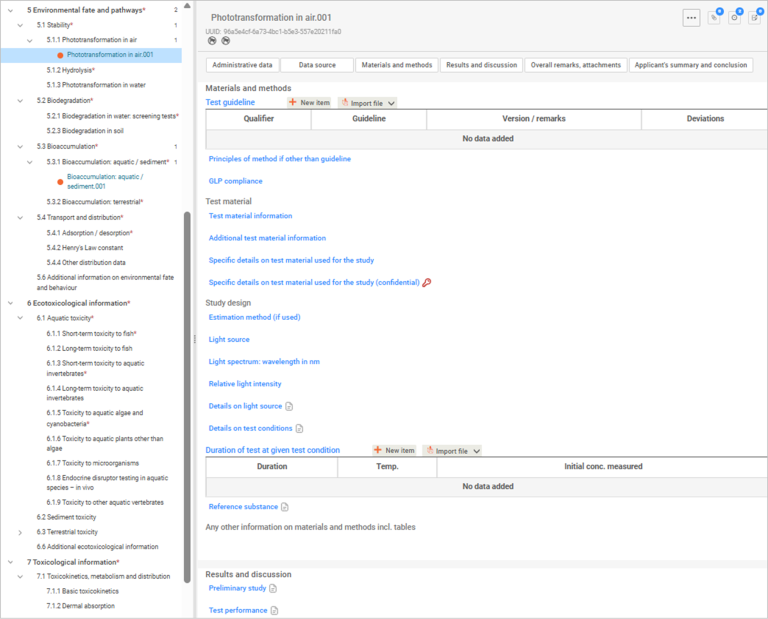
IUCLID – Substances
Introduction
IUCLID uses the Substances feature to store information about individual chemicals.
In regulatory terms, a substance represents a single chemical substance.
IUCLID stores substance datasets under Substances. A substance dataset is a collection of IUCLID documents that together form the chemical dossier for a specific regulatory purpose.
You create and open substance datasets from the Substances section. IUCLID only shows sections and documents after you open a substance dataset.
Validation assistant
Use the Validation assistant to check that your dataset meets AICIS requirements before you submit it.
Read more about validating your chemical dataset in IUCLID.

This image is a screenshot of the 'Validate' and 'Create dossier' buttons in IUCLID.
Table of contents
Once you open a substance dataset, IUCLID displays a table of contents showing all sections and documents in your dataset. The table of contents:
- generates based on the AICIS working context you selected
- shows all required sections and documents for your application type
- organises information into sections and sub-sections.
Use the table of contents as a guide to identify the documents you need to complete. Note that section numbers do not represent a workflow and do not need to be completed in order.
Explore substance sections guidance
IUCLID sections 1–7 do not represent steps. They group information by topic. You do not need to complete them in order.
Section 1 – General information
Introduction
This section explains how to establish the identity, ownership, and technical context of your substance in IUCLID for an AICIS assessment certificate application.
The general information you enter in IUCLID (Section 1) are generally the same for all certificate application types.
The information you enter in Sections 1.1 Identification, 1.2 Composition and 1.4 Analytical information defines:
- the substance (or substances) being assessed
- who is responsible for the application
- how the substance is identified, described and distinguished from similar chemicals.
Much of the information is reused or referenced throughout the IUCLID dataset, including in classification, exposure, hazard and confidentiality decisions. It is therefore important that you complete these sections accurately before moving to the next chapters.
How this section is structured
Each section builds on the previous one.
For example, reference substances selected in Section 1.1 are reused when reporting constituents in Section 1.2, and analytical data in Section 1.4 should support the compositions described.
Confidentiality and publication considerations
Some fields in this section allow you to flag information as CBI. You must provide required justifications.
Some fields cannot be flagged as confidential, such as the substance name as AICIS may use this information for identification or publication purposes.
See our CBI guidance for more information.
Section 1.1 – Identification
This section establishes the identity of your substance and the organisations involved in the application. It is where you enter the key identification details such as the substance name, legal entity, contact details, and how the substance is identified in IUCLID.
The information you enter here forms the basis for other sections of your dataset and is reused throughout the application.
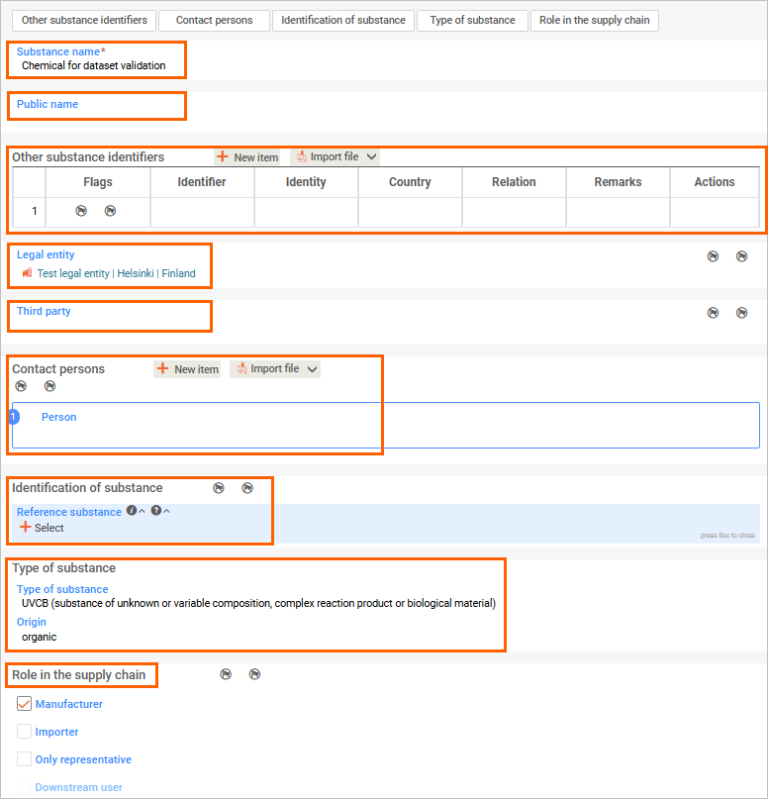
Substance name
This is a unique name in the IUCLID instance and relates to your application in an AICIS working context. You can link this later to reference substance(s) that identifies the substances to be assessed under Identification of substance below and under 1.2 Composition.
Public name
This is the name for publication of the AICIS Assessment Statement. The working legal entity is the legal entity that created the substance dataset or filled in the fields for substance name and legal entity (the 2 mandatory fields in this section).
Other substance identifiers table
- Select New item to provide other information about the identity of your substance.
- You can use the table to flag CBI, with justification.
- Select the type of identifier, (e.g., CAS number, CAS name, trade name) and type the identifier in the free text field.
Legal entity
You can select the legal entity that already exists (created under the inventory manager), or you can create a new one.
Third party
Includes agents and chemical data providers acting on behalf of the applicant. When a third-party legal entity is created, associated contact persons can also be recorded.
Contact persons
Select a contact person created under the Inventory manager or create a new one.
You can set a CBI flag for each contact person.
Identification of substance
- Select a reference substance from the list or create a new one if needed.
- You can flag this as CBI, unlike the substance name.
Type of substance
Select from pick lists – for example, mono or multi-constituent, UVCB, polymer, etc) and origin (e.g., element, inorganic, organic, etc).
You cannot flag these as CBI.
Role in the supply chain
The checkbox under this heading is:
- Manufacturer
- Importer
- Only representative
- Downstream user.
Roles in the supply chain can be flagged as CBI.
Note the distinction between an only representative, a downstream user and an importer in IUCLID:
- Only representative is a natural or legal person established in a certain region, appointed by a manufacturer outside that region to meet the regulatory obligations on importers.
- The importers in the same supply chain are downstream users of the only representative.
Section 1.2 – Composition
This section describes the composition of your substance. You must provide details of the different compositions (if applicable), including constituents, impurities and additives, and their relative proportions.
Your substance may have one or more compositions (for example, multi-constituent substances or UVCBs).
This information defines what your substance is and supports its identification, classification and assessment throughout your application.
Create composition records
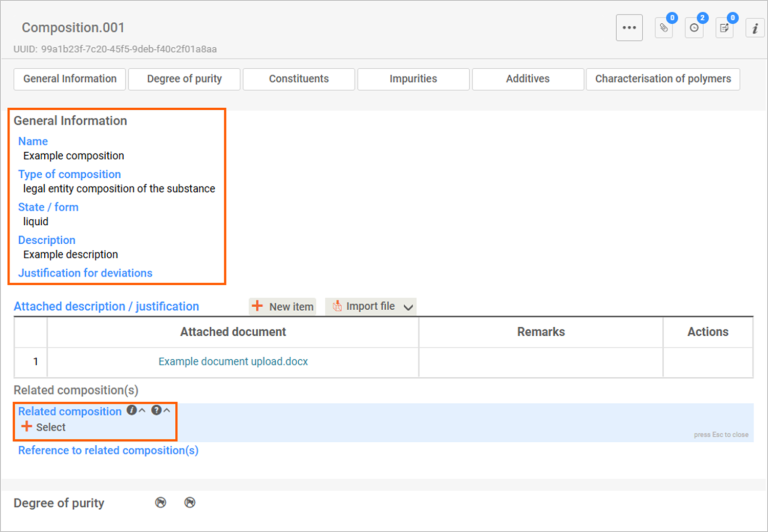
Create a document for each composition (for example, Composition.001).
Complete the General information fields:
- Name (actual composition)
- Type of composition (for example, legal entity composition)
- State/form of the substance.
If you select solid: nanoform, an additional section for nanoform characterisation will appear. You will be able to flag confidentiality when you get to this stage.
Multiple compositions
If your substance has more than one composition:
- link related compositions using Related composition(s)
- provide the purity for each composition
- the information can be flagged as confidential where appropriate.
Constituents, impurities and additives
For each composition:
- provide details of constituents, impurities and additives
- include their relative proportions.
Each composition must include at least one constituent.
To add a constituent:
- select New item
- select or create a reference substance
- enter the concentration of the constituent.
You should:
- complete impurity and additive information where relevant
- indicate whether impurities/additives affect classification and labelling.
Unknown impurities
You can report unknown impurities by:
- creating a reference substance named Unknown impurity
- describing the impurity under Remarks.
Polymers (if applicable)
If your substance is a polymer, complete the Characterisation of polymers section.
You can flag this information as confidential where appropriate.
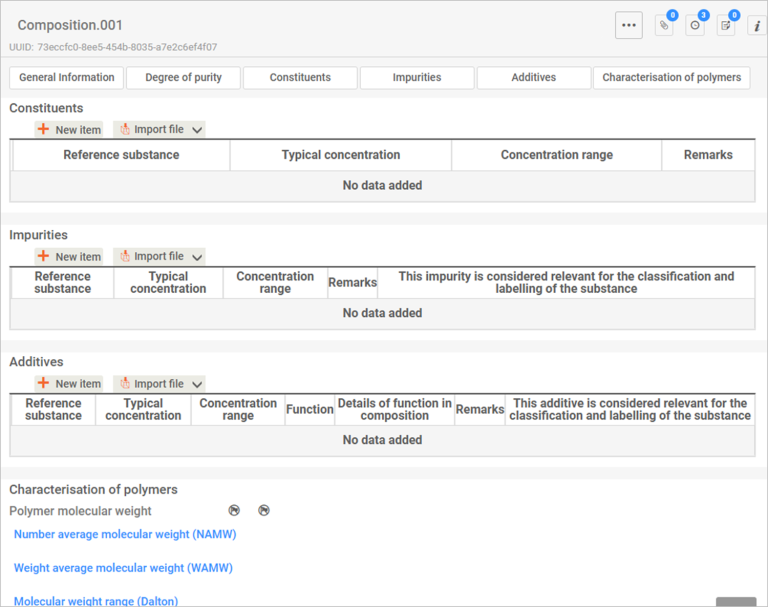
Composition information needed for polymers
Constituents table
Provide identity and percentage of all polymer starting materials.
Impurities table
Provide the percentage residual of each starting material remaining (by weight) following completion of the polymerisation.
Characterisation of polymers
Provide the following:
- molecular weight range
- number average molecular weight (NAMW)
- weight average molecular weight (WAMW)
- the percentage by mass of molecules with molecular weight that are < 1,000 g/mol, and < 500 g/mol
- identity of any moderate or high concern reactive functional groups contained in the polymer
- the functional group equivalent weight (FGEW) (if applicable).
Section 1.4 – Analytical information
This section provides analytical information to confirm the identity of your substance. You must include the methods and results used to characterise the substance.
This information supports and verifies the composition described in Section 1.2.
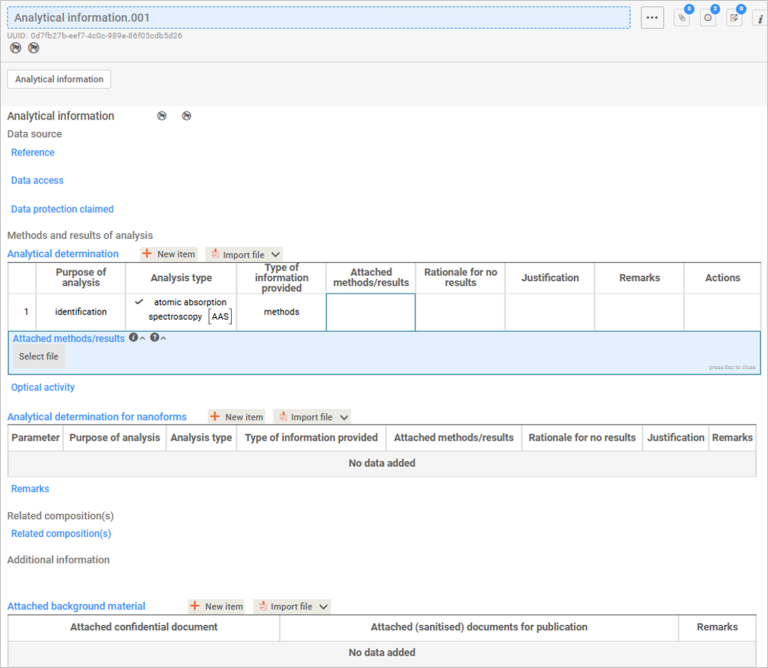
- Create a document (e.g. Analytical information.001) and include the information for each method performed to characterise the identity of your substance in the analytical determination table.
- You must provide enough information to sufficiently characterise the chemical, such as nuclear magnetic resonance (NMR) spectroscopy, liquid chromatography-mass spectrometry (LC-MS) or Fourier-transform infrared (FT-IR) spectroscopy analytical report.
- If introducing a polymer, you must provide a gel permeation chromatography (GPC) or equivalent analytical report.
Methods and results of analysis
- Provide all analytical information in the table. Select New item to add a new entry and set the values of the analytical determination.
- If the purpose is for identification and quantification, make sure you reflect these in the pick list choice.
- Provide more information in Remarks, if needed.
Related composition
You can link a composition (created in Section 1.2 Composition) to this field.
If you are introducing a chemical with multiple compositions, create one analytical information document for each chemical composition.
Section 2 – Classification and labelling
This section records how the substance is classified and labelled for physical, human health and environmental hazards.
The classification and labelling information you enter in IUCLID (Section 2) is generally the same for all certificate application types
You must classify your chemical according to the Globally Harmonised System (GHS) and provide the relevant hazard information. This information is required for all application types and supports the assessment of risks to human health and the environment.
See Types of assessment applications and information required in the Guide to applying for an assessment certificate for a summary of information required for this section.
Section 2.1 – GHS
Create one document for each GHS record.
A GHS classification record includes all hazard endpoints for a substance or composition. You may need more than one record where classifications differ (for example, for different compositions such as UVCBs).
Use a clear and descriptive document name, including concentration, where relevant. For example, GHS classification of substance with more than or equal to 1% concentration.
You can flag CBI and restrict regulatory use (by jurisdiction) for each document.
Complete information under the following headings:
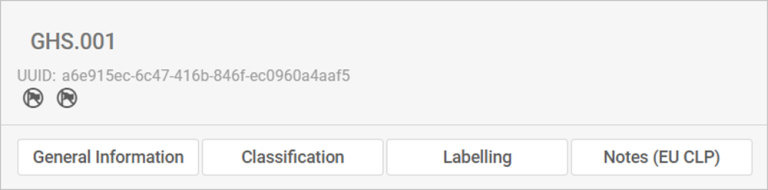
General information
- Enter the chemical name as it appears on the record, such as the name used in a safety data sheet.
- Select the Not classified checkbox if your substance is not classified.
- Under Implementation select the relevant jurisdictions for the classification. Link the classification to the relevant composition under Section 1.2 Composition.
- Under Type of classification, select whether classification is harmonised (GHS) or self-classification (by the manufacturer or importer).
- Use a descriptive name for the substance (including concentration where relevant).
- Create a different document for each distinct classification.
Classification
- You will find a long list of hazard endpoints covering physical, human health and environmental hazards.
- Review all endpoints and classify those that are relevant by completing the Hazard category and Hazard statement.
These fields must match – so the right hazard statement goes with the right category.
Important: Data lacking is selected by default under Reason for no classification, which deactivates Hazard category and Hazard statement. This setup reflects the reality that most of these hazard endpoints lack sufficient data for classification.
Remove Data lacking in Reason for no classification to activate these fields.- Some endpoints under human health hazard also require you to indicate the specific effect and route of exposure.
- If you have information on specific target organ toxicity, single or repeated exposure, you can report this using repeatable tables.
- You can also provide information on specific concentration limits for environmental hazards, the ozone layer and other additional hazard classes.
Labelling
Complete all labelling fields, including:
- GHS hazard statements
- Additional non-GHS hazard statements (if applicable).
Notes
Use this field to provide additional context or explanations.
Section 3 – Manufacture, use and exposure
The manufacturing information you enter in IUCLID Section 3 is generally the same for all certificate application types
See Types of assessment applications and information required in the Guide to applying for an assessment certificate for a summary of information required for this section.
Get started with Section 3
In this section, you must describe how your substance is manufactured, supplied and used, and identify where exposure to people and the environment may occur.
We recommend you first map the process (lifecycle) of the substance (for example, using a simple diagram) to understand how the substance is manufactured, handled and used.
Exposure scenarios (use descriptions)
In IUCLID, exposure scenarios are also called 'identified uses' or 'use descriptions'.
Assign exposure scenarios (use descriptions) for each stage of the substance’s lifecycle, including:
- manufacture
- formulation or re-packing
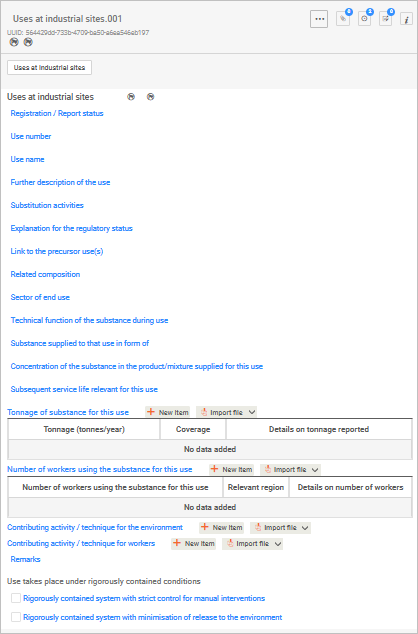
- uses at industrial sites
- widespread uses by professional workers
- consumer uses.
Although manufacture is not a ‘use’, you must still describe it as part of the substance's lifecycle.
Volume allocation
You must allocate the total annual quantity of the substance across lifecycle stages and use scenarios (for example, manufacture, formulation and end use).
- Enter the total annual tonnage provided in Section 3.2 Estimated quantities.
- In sections 3.5.1 to 3.5.5, enter only the portion relevant to each activity or use.
The total across all activities and uses must match your Section 3.2 estimates.
Common fields across Section 3
The following fields appear in most Section 3 documents:
- Tonnage of substance for this use
- Details on tonnage reported
- Number of workers using the substance
- Contributing activities (environment and workers)
- Use takes place under rigorously contained conditions.
Complete these fields consistently across all relevant sections.
Reporting tonnage across Section 3
You must report annual tonnage in Section 3.2 and allocate this across activities and uses in sections 3.5.1 to 3.5.5. The totals across all uses must match your Section 3.2 estimates.
Naming and describing activities
- Use clear, descriptive names that distinguish each activity or use.
- Avoid generic names such as Activity 1.
- Provide a detailed technical description of each process or use.
General tips for Section 3
- Use Remarks to provide additional context (for example, assumptions or estimates).
- Link existing data (sites, compositions, entities) where possible.
- Flag CBI only where appropriate and provide justification.
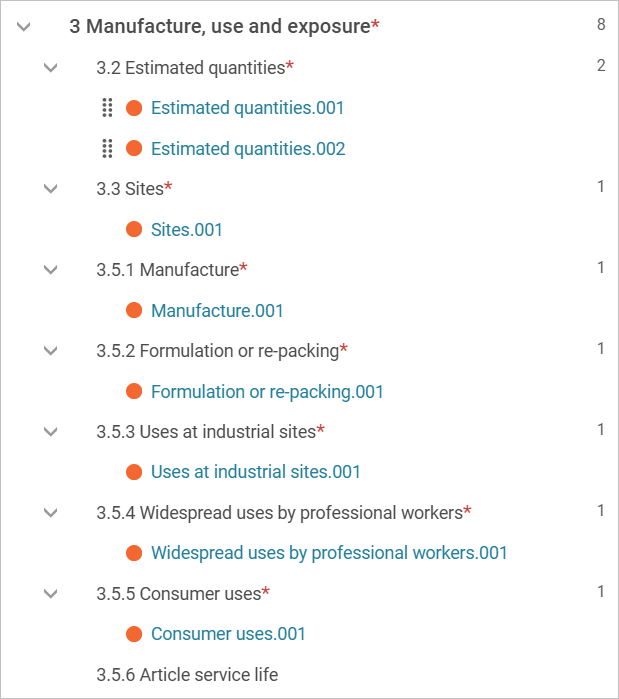
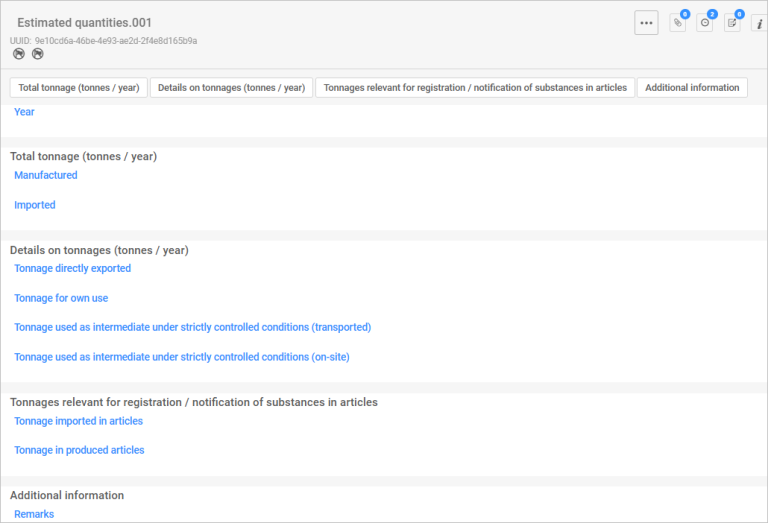
3.2 – Estimated quantities
In this section, you must report the total annual quantity of your substance for each year of the 5-year certificate period.
To report quantities:
- Create 5 documents (one for estimated quantities for each of the 5 years of the certificate). Select the plus button (+) to create each document.
- Enter the total annual tonnage (manufacture and import combined) for each year:
- Estimated quantities.001 (first year)
- Estimated quantities.002 (second year)
- Estimated quantities.003 (third year)
- Estimated quantities.004 (fourth year)
- Estimated quantities.005 (fifth year).
You can flag CBI and restrict regulatory use (by jurisdiction).
Use Remarks to provide any extra information. For example, details of flagged CBI. Be specific on which tonnage you wish to flag (import, manufacture or both). Also provide:
- justification for flagging the specific tonnage
- the tonnage value you want published (the non-CBI value).
3.3 – Sites
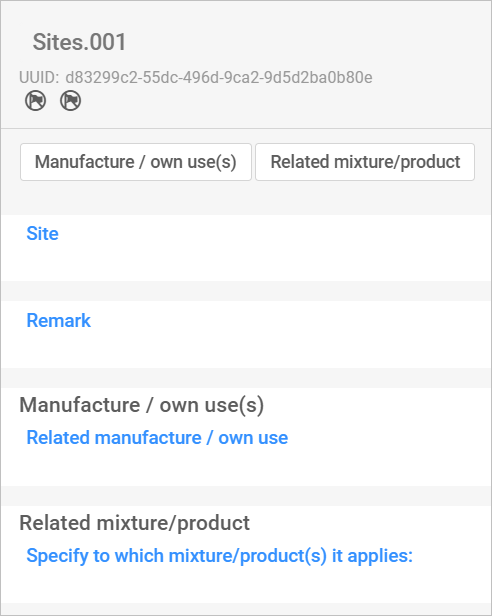
Add and select sites
- Add all relevant sites (Australia or overseas).
- Select the plus button (+) and choose from existing sites. If your site is not on the list, select Create to add a new one.
- For each site, you can flag CBI and restrict regulatory use (by jurisdiction)
Link sites to activities
For each site you have selected or created link to all applicable activities:
- Manufacture – Section 3.5.1 Manufacture
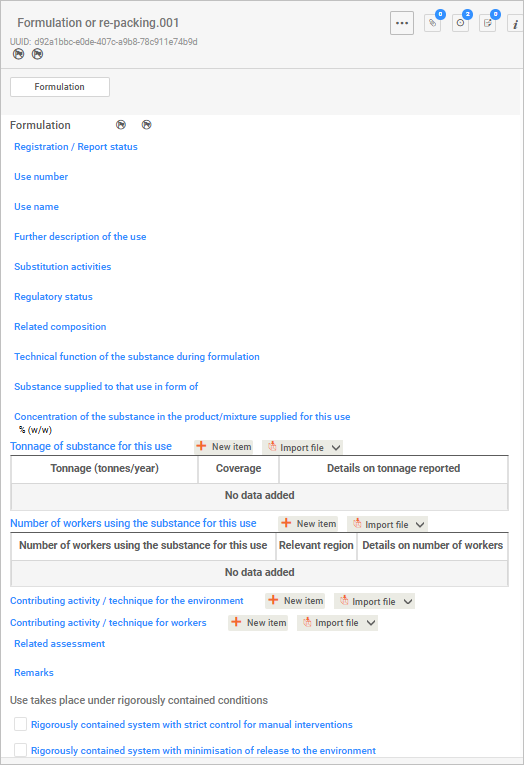
- Formulation – Section 3.5.2 Formulation or re-packing
- Use at industrial sites – Section 3.5.3 Uses at industrial sites.
3.5.1 – Manufacture
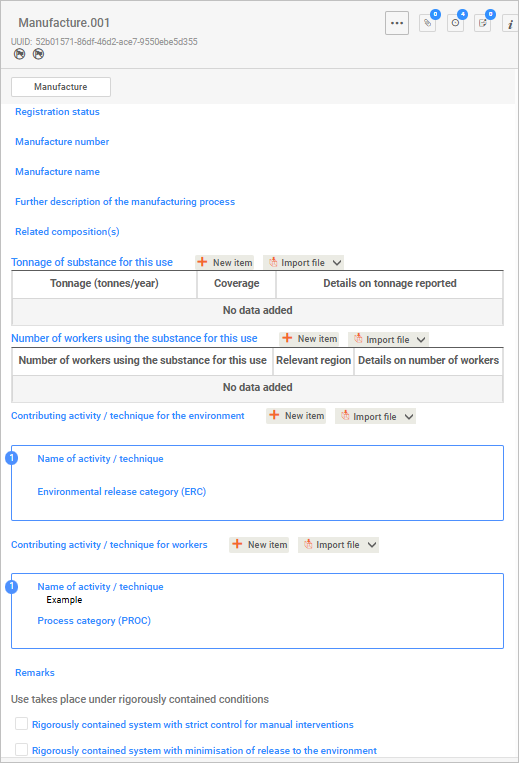
In this section, you must describe how the substance is manufactured.
Create one document per manufacturing activity.
Key fields
Manufacture name
Use a clear, descriptive name that distinguishes each manufacturing activity from others.
Further description of the manufacturing process
Provide a detailed technical description of the process. Include relevant operational steps, diagrams, tables, or other structured information, if useful.
Related composition
You can link a composition created in Section 1.2 Composition, if relevant.
Tonnage of substance manufactured (tonnes/year)
- Enter the annual tonnage for the manufacturing activity. Do not enter your total import or manufacture volume (as reported in Section 3.2 Estimated quantities) – only the portion used for this activity.
- Select Coverage from the pick list or select Other if the value is not listed and enter the relevant information.
- Use Details on tonnage reported to explain the reported tonnage, including assumptions, estimates or projections.
Number of workers using the substance for this use
Enter the number of workers involved in the activity.
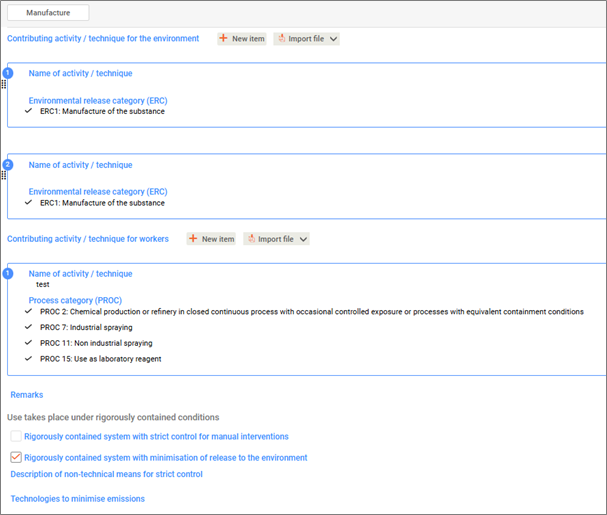
Contributing activity / technique for the environment (ERC)
- List as many activities and techniques relating to the environment as relevant.
- Select New item and enter a descriptive name.
- Review the Environmental release categories (ERC) carefully and select those that apply.
Contributing activity / technique for workers (PROC)
- List as many activities and techniques relating to workers as relevant.
- Select New item give a descriptive name.
- Review the Process categories (PROC) carefully and select those that apply.
Use takes place under rigorously contained conditions
Select the option that best describes the conditions for this activity or use. Different/additional fields will display depending on your selection.
3.5.4 – Widespread uses by professional workers
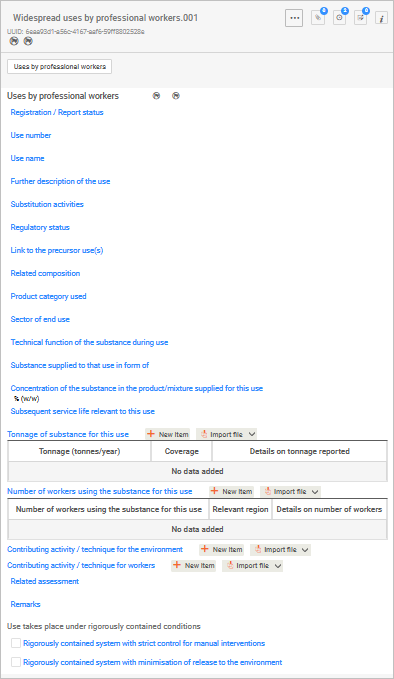
The fields required in this section are the same as those in Section 3.5.3 Uses at industrial sites, adapted for the relevant use type.
This section describes widespread use by professional workers.
Create one document for each type of widespread use.
3.5.5 – Consumer uses
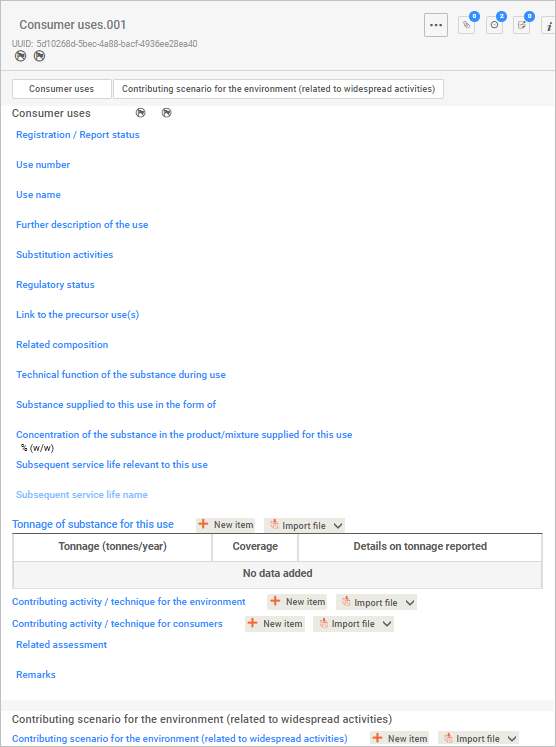
The fields required in this section are the same as those in Section 3.5.2 Formulation or re-packing adapted for the relevant use type.
This section describes consumer uses of the substance.
Create one document for each type of consumer use.
Key fields
Regulatory status
Use this field to elaborate on the international regulatory status.
Technical function of the substance during use
Select all functions that apply (multiple selections allowed).
Section 4 – Physical and chemical properties
This section records intrinsic physical and chemical characteristics of the substance.
The physical and chemical properties you enter are generally the same for all certificate application types.
You must provide core physicochemical properties (for example, melting point, boiling point, density, vapour pressure and water solubility). Some properties are only required if available, depending on your chemical and data you hold.
See Types of assessment applications and information required in the Guide to applying for an assessment certificate for a summary of information required for this section.
If you cannot provide information for a required physical and chemical property endpoint, you must request an information waiver and provide appropriate justification.
See our information waivers guidance
Important: Do not select ‘experimental study planned’ or ‘experimental study planned (based on read-across)’. AICIS does not accept these options.
Note: these hints are for all endpoints (e.g., melting point, density, etc).
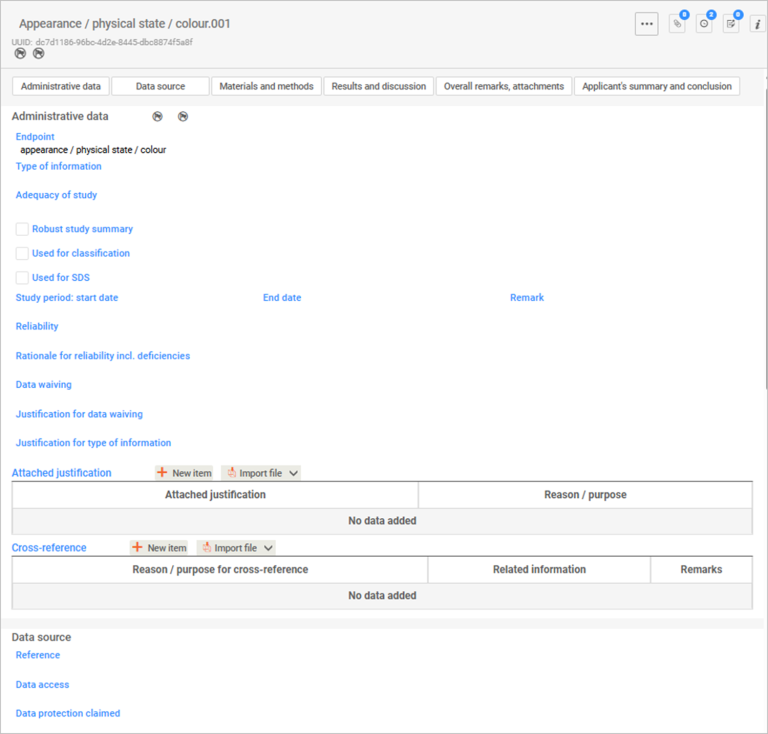
Administrative data
This information is not eligible for flagging as CBI:
– Physical and chemical data that do not reveal the chemicals composition.
– Summaries of data relating to risks to human health or the environment.
Use the help text provided to complete the fields of each endpoint.
Endpoint
Select the endpoint from the pick list.
Even though the endpoint is clearly indicated in the title (e.g., Boiling point.001), there may be more than one endpoint title. In the case of boiling point, you can select either boiling point or temperature of decomposition.
Provide any comments under Remarks about the endpoint, such as the subtitle of the endpoint report.
Type of information
Select from the pick list to specify the basis of the endpoint study.
If you are applying to waive an information requirement – you will need to provide a justification. If applying, select an option in the data waiving and justification pick list. You can also select other justification then describe what it is, if the standard phrases provided do not meet your circumstances.
Adequacy of study
Select the description from the picklist of how the endpoint study above is used to meet the information requirements for the chemical under your assessment certificate application.
Study period
this information is required to determine if an animal test study is the right information to provide if your chemical is for cosmetic use only.
Data source
This is the literature reference for the endpoint study record.
You can create this through Literature reference under Inventory manager. You can also create the reference here once a pop-up window appears.
Select Create for more than one Literature reference.
Data access and Data protection claimed
This information is required if you are seeking to protect CBI.
Materials and methods
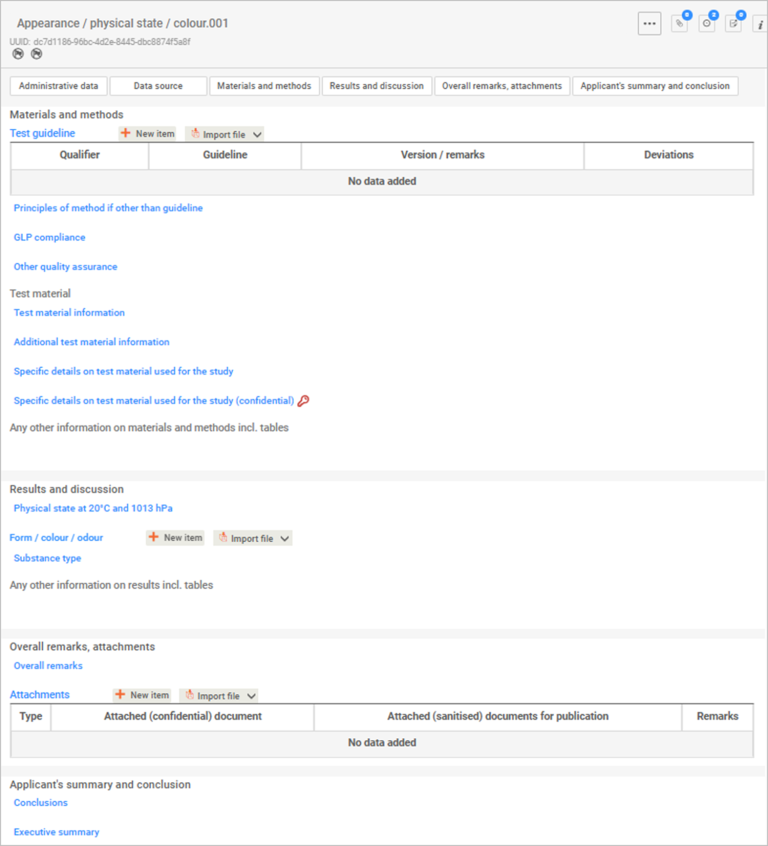
Test guideline – this is a critical field as it identifies the guideline used and whether this is acceptable, based on our requirements. Depending on the endpoint, a pick list is available for you to select the relevant test guideline. For example, Organisation for Economic Co-operation and Development (OECD) Guideline 103.
If the test was not conducted according to a test guideline, provide details on the principles of the method used – this is a free text field with a guidance template:
- whether the test conducted using this method was compliant
- whether it followed other quality standards
- and the actual type of test method (pick list).
Test material – You can select your test material information from a reference substance or test material reference.
You can also flag specific details of the test material as CBI and provide other information about the test materials.
Results and discussion – Select New item to enter results. Indicate if the result is a key result (see Key Administrative data fields below) and provide more information under Remarks. You can also include tables or other structured information where needed.
Overall remarks – Use this to provide context or clarify study details, if needed.
Attachments – You must attach supporting files. This includes:
- the full study report
- any relevant illustrations, images or graphs.
Applicant’s summary and conclusion – You can describe the main conclusions of the endpoint study here.
Sections 5, 6 and 7 – Environmental fate and pathways, Ecotoxicological and Toxicological information
Although these sections address different endpoints, the IUCLID document structure and fields are largely the same across Sections 5, 6 and 7. This guidance applies to all 3 sections unless we state otherwise.
What each section covers
- Section 5 – Environmental fate and pathways: records studies and information on how the substance behaves in the environment (for example, degradation, distribution and transport).
- Section 6 – Ecotoxicological information: records studies on the effects of the substance on environmental organisms (for example, aquatic and terrestrial species).
- Section 7 – Toxicological information: records studies and information on the effects of the substance on human health.
Information requirements and waivers
Provide all required endpoint information for your application type, as set out in the general assessment certificate application guide.
If you do not have the required information for an endpoint, you must request an information waiver and provide appropriate justification.
See our information waivers guidance
Important: Do not select ‘experimental study planned’ or ‘experimental study planned (based on read across)’. AICIS does not accept these options.
General guidance for Sections 5, 6 and 7
When completing documents in Sections 5, 6 and 7:
- refer to our list of required endpoints based on your application type – see our general assessment certificate application guide
- include any other relevant information you have
- use the IUCLID help text complete each endpoint field.
Endpoint study records
IUCLID captures data at the endpoint study record level in each section.
- Navigate through the endpoint hierarchy until you see a plus (+) symbol.
- Select the plus symbol to add a new endpoint study record (for example, Short-term toxicity to fish).
- You can add multiple endpoint study records for the same endpoint. IUCLID automatically assigns unique document numbers. Each record has its own Universally Unique Identifier (UUID).
- Make sure that the data you provide in IUCLID documents match the actual study report.
Administrative data
Use the Administrative data section to manage confidentiality, regulatory use and study context.
- You can flag CBI and restrict regulatory use (by jurisdiction).
- Flagging through Administrative data automatically flags the whole section.
- You can enter data into an endpoint study record through both structured (e.g., pick list and repeatable tables) and unstructured (e.g., plain and free text) fields.
Some fields appear or disappear depending on your earlier selections.
For example, if you selected Experimental study under Type of information, the option to waive data will not be available.
If you selected an incorrect state or form for a substance (for example, for a nanoform), nanoform-related fields may not appear.
Key Administrative data fields
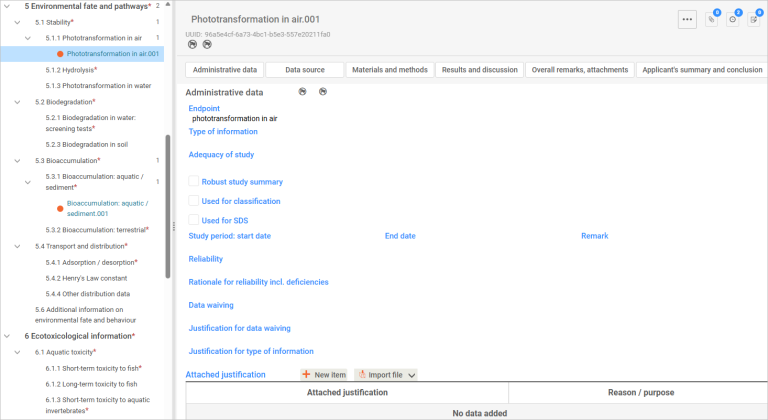
Endpoint – select the type of endpoint from a pick list. If there is only one type, the name of the endpoint record is the only choice. Provide any comments about the endpoint under Remarks, if needed.
Types of information – your selection determines which fields appear for you to complete.
Adequacy of study – select the description of how the endpoint study meets the information requirements from the pick list (see table below) for the chemical under your assessment certificate application.
| Study type | Explanation |
|---|---|
| Key study | A study that is relevant, adequate, and reliable. We expect that they will relate to a robust study summary included with the certificate application. If there is more than one key study, then use the study with the highest hazard profile. Make sure you also describe reasons why you chose the study as the key study. Include this in the Justification for type of information field. |
| Supporting study | A study that provides extra information supporting the conclusions of the key study. |
| Weight of evidence | Select this option where your submission relies on multiple studies for the same endpoint. This approach suggests that there is no single relevant, adequate, or reliable study available to reach a conclusion and that multiple studies are needed to make a conclusion about the particular property of the chemical. Include reasons describing why you chose a weight of evidence approach under Justification for type of information. |
| Disregarded due to major methodological deficiencies | Select this option where a study result shows a higher hazard profile than a key study result, but the methodology or documentation is unreliable, inadequate or irrelevant. Include reasons why this study was disregarded under Justification for type of information. |
| Other information | Select this option when information is available for the endpoint, but it does not meet the criteria for classification as disregarded due to methodological deficiencies. |
Use the help text for guidance for other fields under Administrative data.
Data waiving – select the reason for waiving study data. Provide justification under Justification for data waiving.
Justification for type of information – justify the type of information for the endpoint study record. You can select from existing templates for most types of information that is not an experimental study.
Attach justification – you can also attach files for your justification(s) through repeatable tables.
Cross reference – link to related information already stored elsewhere in the dataset so it doesn’t need to be uploaded again.
Select New item to use the repeatable tables. Set the values by filling in the pop-up fields – this allows you to select the stored reference(s).
Data source – this is the literature reference for this endpoint study record.
You can create this through Literature reference under Inventory manager. Or you can create the reference on the page in the pop-up window. Select Create for more than one literature reference.
Data access and Data protection claimed – required information if you are seeking to protect CBI.
Materials and methods
Use the help text to complete all fields. Key fields include:
- Test guideline – This is a critical field as it identifies the methodology used to generate the data. Recording the test guideline allows assessors to evaluate the reliability, comparability, and regulatory acceptability of the study.
- Repeatable tables – use these to include one or more applicable guidelines.
- OECD test guidelines – You will find it easier to fill in documents using studies conducted using OECD test guidelines, as AICIS working contexts follow OECD harmonised templates.
Principles of method if other than guideline – you can use the available templates for QSARs and for a non-guideline study.
You can also indicate GLP compliance as indicated in the study.
Test material information – select the appropriate test material from the pop-up list. You can only select one test material. If you have not yet created the test material reference, select Create.
Specific details on test material used for the study – provide as many details as possible on the test material.
Specific details on test material used for the study (confidential) – details that are confidential are provided in this field.
Fill in all the fields under materials and methods using the help text to guide you.
Any other information on materials and methods including tables – you can include detailed text as well as tables or other structured information where needed.
Results and discussion
Section-specific differences
Section 6 – Ecotoxicological information: Use Effect concentrations to report results.
Section 7 – Toxicological information: Use Effect levels to report results.
Apart from this difference, complete the remaining fields in the same way.
Completing results
Effect concentrations
Flag key results by selecting Key result. Use the templates to provide details on the results (test substance, positive control and negative control).
Reported statistics and error estimates – provide these in the text field.
Sublethal observations / clinical signs – record these observations and include any relevant details.
Overall remarks
This field is optional. Use it to provide more context or clarify study details.
Attachments
You must attach background material under the appropriate table, such as:
- the full study report for experimental data
- for analogue approaches, full articles or reports generated from appropriate computational models (for example, Quantitative Structure-Activity Relationship (QSAR) data).
We do not publish study reports you provide us.
Applicant’s summary and conclusion
You can:
- indicate whether validity criteria in the test guideline were met and explain why under Remarks
- provide conclusions and an executive summary of the results.